

The East West Link project will enhance access to and from the Onehunga-Penrose industrial area by creating improved transport connections to and from State Highway 1 and State Highway 20, supporting economic growth, productivity, and improve travel times and reliability through this busy area.
NZTA has been re-investigating the East West Link (EWL) project in line with today’s Government Priority Statement (GPS) priorities to focus on prioritising land transport investments that drive economic growth and enhance productivity, highlighting the importance of moving people and freight efficiently, quickly, and safely.
The East West Link project will enhance access in and out of the Onehunga-Penrose industrial area by creating improved connections to and from State Highway 1 and State Highway 20, supporting economic growth, productivity, and improving travel times and reliability through this busy area.
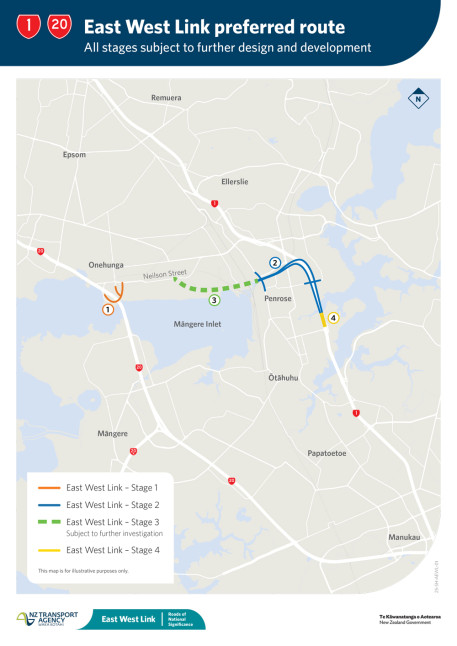
The most recent 2025 review of the EWL project builds on previous work to consider the project afresh within the context of current policy and the need to maximise value for money and affordability. A preferred (revised) corridor is being developed for EWL that will enhance access in and out of the Onehunga-Penrose industrial area by:
maximising the use of existing road network (including using the existing Neilson Street corridor)
providing flexibility for staging, enabling delivery in cost effective incremental stages
providing an inland route to connect businesses
reducing environmental impacts, largely avoiding the foreshore area of the Māngere Inlet.
The proposed revised corridor differs from the previous alignment but has a similar footprint east of Great South Road and east of SH20 around Onehunga Harbour Road (including Galway Street).
The next 12-months will involve more design work to develop, refine and route protect the preferred (revised) corridor, whilst looking at ways to stage sections of the project with a focus on Stage 1, Galway Link. We will be engaging with local stakeholders, landowners and businesses in the coming weeks and months, and undertaking ground and environmental investigations to help inform this work.
More work is required before NZTA can confirm the land we need for the future road. When we have done that, and spoken with landowners and businesses, we plan to lodge applications for statutory approvals to protect the land needed for the project. We expect this to happen late 2026.
There is currently a proposed designation for the EWL project. This has been in place since a Notice of Requirement was lodged with the Environmental Protection Authority in December 2016. We understand this causes a level of uncertainty, however this notice remains in place until a decision has been made that it is no longer required.
This stage of the project is about progressing pre-implementation and route protection to build a strong pipeline of projects for future construction.
The Onehunga-Penrose area is a key locality for New Zealand’s industrial and manufacturing economy and its transport network, where almost 30% of Auckland’s manufacturing jobs are based, making up about 8% of the region’s economy. Many of the largest distribution and logistics facilities in New Zealand are based in the area because it is accessible to arterial routes, state highways, the rail network, the Auckland International Airport and ports.
With business land in high demand and employment expected to grow by 30%, this area is poised for major expansion. Without reliable connections, this growth is put at risk. For businesses who call this area home, transport is a major business cost and inefficiencies hit the bottom line.
Recent studies show that without investment, by 2051 it will take up to 36-minutes to access the area to and from SH1 and SH20.
East West Link investment case summary [PDF, 2.4 MB]
East West Link is a strategic investment in Auckland’s future. It’s a plan to improve transport links in the area, reducing delays and helping businesses moving goods and people efficiently, and supporting growth. By easing congestion, enhancing connectivity, and unlocking growth, the project will help create a more efficient and productive industrial heartland.
East West Link will be staged over time with more investigation and design work planned before confirming exact features of the project. The recent 2025 investment case proposes:
Recent work on NZTA’s 2025 East West Link investment case show:

![View larger map [JPG, 429 KB]](/assets/projects/east-west-link/east-west-link-project-map-stages.jpg)