
| This consultation has now closed. |
We’re proposing changes to some speed limits in Otago under the Setting of Speed Limits Rule 2024 so they better match road layouts and land use, and address community safety concerns.
When considering new speed limits for SH1 Hampden and SH8 Ettrick, we look at crash data, road type, and how people use these roads. Lower speeds help reduce crashes and make intersections easier to navigate. The proposed limits follow the Setting of Speed Limits Rule 2024 and offer a cost-effective way to improve safety for local communities.
Hampden is a small township located 6.4km north of Moeraki, either side of SH1 with a population of 410 (as of June 2024). It sees an average of 4,712 vehicles per day (15% heavy). The town centre, situated on a hill, is a busy area with shops, a library, a police station, and cafes. There's strong community support for reduced, more consistent speeds to help address driver confusion and potential safety risks for pedestrians, particularly children crossing the road near parked trucks.

|
State highway section |
Road classification |
Approximate length (km) |
Current speed limit (km/h) |
Proposed speed limit (km/h) |
|
SH1 Hampden Lancaster street to Shrewsbury Street |
Peri-urban |
0.47
|
80 |
70 |
|
SH1 Hampden Shrewsbury Street to Nottingham Street |
Peri-urban |
0.97 |
60 |
50 |
As part of this speed review, we consider the implementation costs and overall safety, and travel time impacts of the proposed speed limit changes in a Cost Benefit Disclosure Statement (CBDS).
Implementation costs if the speed limit changes from 80km/h to 70km/h are approximately $10,000, costs may include such things as planning, road signs and markings, installation costs, overheads, and consultation and administration costs.
If the speed limit reduces from 80 km/h to 70 km/h, the expected travel time increase for both light and heavy vehicles is around 1 second for each journey.
It's estimated that there would be a 10% reduction in all injury crashes if the speed limit changed from 80km/h to 70km/h.
As part of this speed review, we consider the implementation costs and overall safety and travel time impacts of the proposed speed limit changes in a Cost Benefit Disclosure Statement (CBDS).
Implementation costs if the speed limit changes from 60km/h to 50km/h are approximately $5,000, costs may include such things as planning, road signs and markings, installation costs, overheads, and consultation and administration costs.
If the speed limit reduces from 60 km/h to 50 km/h, the expected travel time increase for both light and heavy vehicles is around 5 seconds for each journey.
There haven’t been any recorded injury crashes in this area, so we don’t expect a reduction in injuries. However, lowering the speed limit from 60 km/h to 50 km/h can still make the road feel safer and more comfortable for everyone.
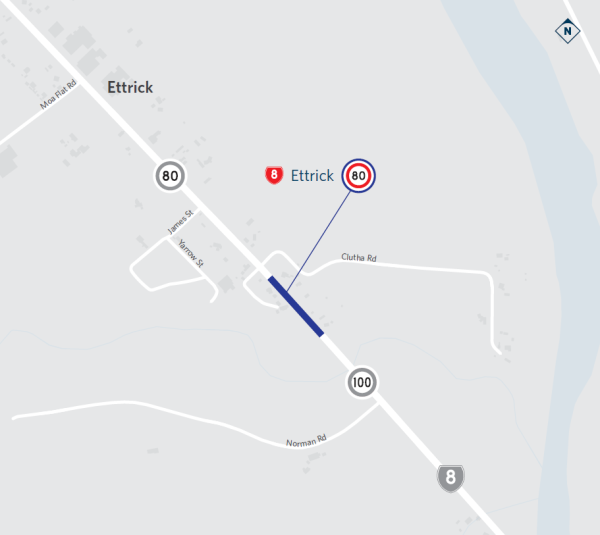
CloseEttrick is a small Central Otago township along SH8, a key corridor linking Roxburgh, Lawrence, and Alexandra. With a population of around 170 and daily traffic averaging 2,531 vehicles per day (12% heavy), safety concerns have been raised about the southern end of the township due to limited sight distance from a hill and nearby land use activity. While the township itself isn’t under review at this stage, the southern end is being considered for speed management.
|
State highway section |
Road classification |
Approximate length (km) |
Current speed limit (km/h) |
Proposed speed limit (km/h) |
|
SH8 Ettrick Extension at southern end |
Peri-urban |
0.23 |
100 |
80 |
As part of this speed review, we consider the implementation costs and overall safety, and travel time impacts of the proposed speed limit changes in a Cost Benefit Disclosure Statement (CBDS).
Implementation costs if the speed limit changes from 100km/h to 80km/h are approximately $15,000, costs may include such things as planning, road signs and markings, installation costs, overheads, and consultation and administration costs.
If the speed limit reduces from 100 km/h to 80 km/h, the expected travel time increase for both light and heavy vehicles is less than 1 second for each journey.
There haven’t been any recorded injury crashes in this area, so we don’t expect a reduction in injuries. However, lowering the speed limit from 60 km/h to 50 km/h can still make the road feel safer and more comfortable for everyone.
CloseWhen we looked at all the possible safety options for this area, Intersection Speed Zones (ISZ) were the best choice. We consider factors like crash data, road conditions, traffic volumes, and current speeds. ISZs use Variable Speed Limits (VSLs), which are a practical, low-cost way to improve safety and make access to busy roads easier.
Intersection Speed Zones are used to improve the safety at rural intersections along high-speed roads.
They detect when a vehicle is approaching the intersection to either turn into or out of the side road, activating the electronic variable speed limit sign to temporarily show a lower speed limit on State Highway 6. This makes it easier and safer for people to pull into or out of a side road across a high-speed rural road.
Watch this video to learn how Intersection Speed Zones work.
The proposed 100/60km/h variable speed limits fit the recommended range for ISZs on interregional connector state highways and ensure consistency for drivers.
The SH1 Moeraki intersections have a history of serious crashes. We’re proposing a new Intersection Speed Zone (ISZ) and an update to the existing ISZ in this area, both with a consistent 100/60 km/h variable speed limit. This approach improves safety and makes speed limits easier for drivers to understand. Moeraki is a small coastal village located along the stretch of SH1 between Hampden and Palmerston which is a high-risk section of highway for road crashes. 4,647 vehicles per day travel through this area on the main route connecting the South Island’s main cities of Christchurch and Dunedin – 16% of traffic is heavy vehicles. The railway crossing is near the state highway which increases crash risks at intersections.
This area is a popular destination for visitors to the Moeraki Boulders. There is a mix of traffic – buses, camper vans, and occasional cyclists – with drivers/riders turning on and off the busy highway. All this activity increases the crash risks for everyone using this road.
Right turn bays at both SH1 intersections have helped to improve safety, however the addition of a new ISZ at Hillgrove Road and a speed limit adjustment to the existing ISZ at Moeraki Boulders Road will further improve safety for turning vehicles and everyone using this road.
This intersection is in a high-risk crash area. Hillgrove Road provides sole access to the coastal settlement of Moeraki village. A VSL here was consulted on and approved under the 2022 rule. This speed change was not implemented by the 30 October 2024 deadline and needs to be consulted on under the 2024 rule.
|
State highway section |
Road classification |
Approximate length (km) |
Current speed limit (km/h) |
Proposed speed limit (km/h) |
|
SH1 Moeraki Hillgrove Road intersection |
Interregional connector |
0.36 |
100 |
60 (variable) |

As part of this speed review, we consider the implementation costs and overall safety and travel time impacts of the proposed speed limit changes in a Cost Benefit Disclosure Statement (CBDS).
View the full CBDS assessment for this speed limit review [PDF, 136 KB]
Installing a new ISZ is expected to cost around $200,000 to $240,000. This includes planning, specialist technology, equipment and connections, testing, road signs and markings, installation, consultation, and administration costs.
The expected travel time increase per trip with a 60km/h variable speed limit for light vehicles is around 1 second and for heavy vehicles less than 1 second for each journey. (Noting a 90km/h speed limit applies to heavy and towing vehicles.)
Based on research, it is estimated there would be a 69% reduction in all injury crashes.
Intersection speed zones case study(external link)
CloseThe existing ISZ on SH1 at Moeraki Boulders Road was installed in June 2017 to enhance safety at this popular tourist destination, which is in a high-risk crash area. Its installation followed a safety assessment prompted by a fatal crash in 2016 and ongoing community concerns. Between 2011 and 2016, 5 crashes were recorded at this location, resulting in one fatality, one serious injury, and 4 minor injuries. From 2017 to and 2024, there were 5 crashes, one fatal, one serious injury and the remainder non-injury.
We are now proposing to adjust the current 100/70km/h variable speed limit to 100/60km/h, aligning it with the proposed new ISZ approximately 1.1 kilometres to the south on SH1 at Hillgrove-Moeraki Road.

|
State highway section |
Road classification |
Approximate length (km) |
Current speed limit (km/h) |
Proposed speed limit (km/h) |
|
SH1 Moeraki Moeraki Boulders Road intersection |
Interregional connector |
0.30 |
100/70 (variable) |
100/60 (variable) |
As part of this speed review, we consider the implementation costs and overall safety, and travel time impacts of the proposed speed limit changes in a Cost Benefit Disclosure Statement (CBDS).
View the full CBDS assessment for this speed limit review [PDF, 136 KB]
Adjusting the existing ISZ is expected to cost around $50,000, this includes planning, updating equipment, specialist technology, testing, and new road signs and markings. Because this is an existing ISZ, costs are lower than installing a new one, and the work could be done at the same time as the proposed new ISZ if approved.
The expected travel time increase per trip with a 60km/h variable speed limit for both light and heavy vehicles is less than 1 second for each journey compared with a 70km/h variable speed limit (Noting a 90km/h speed limit applies to heavy and towing vehicles.)
Intersection speed zones case study [PDF, 976 KB]
CloseThis consultation closed on Friday 30 January 2026.
The areas covered were:
After consultation, we’ll publish a summary report outlining what changes were made (or not) and why.
Under the rule, NZTA must consider community feedback as part of decision-making and document the following information in a Cost Benefit Disclosure Statement (CBDS):
All 4 of these speed limit change proposals align with the Government’s Road Safety Objectives which include taking a balanced and targeted approach to speed limits by considering safety, economic impacts – including travel times – and community views.
The information you sent us on the online form or in a written submission will be used by NZ Transport Agency Waka Kotahi (NZTA) to help inform our consultation for speed limit reviews in Otago. NZTA may publish in part or in full the information you submit, for example in a consultation report, but we will not include any information that could be used to identify an individual person. If you have indicated you are an authorised representative of an organisation, we may publish your organisation’s name. Please clearly indicate if your comments contain commercially sensitive information or, if for some other reason, they should not be disclosed.
You can find more about how we hold and protect your information, and our obligations under the Official Information Act on our website.
Consultation - privacy and Official Information requests
If you would like to request official information from us, please direct it to the project team.
To help us analyse the feedback we receive through this consultation, we may use artificial intelligence (AI) tools. These tools can assist us in identifying common themes and summarising responses more efficiently. Any use of AI will follow our privacy and data protection standards, and your feedback will always be reviewed by our team to ensure fair and accurate reporting.
